 Technical Support
 Feedback



Authors: Yu Hao, Cai Yongxiang, Bu Yuzhou, Xie Qiansi
Source: Beijing New Materials Development Center; edited and compiled by Changsha Ligao Jiechuang Instrument Co., Ltd.
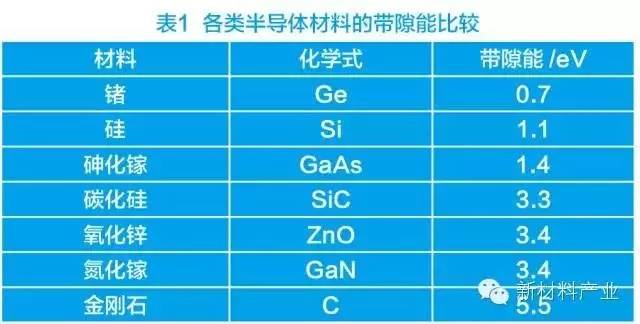
Third-generation semiconductors refer to wide-bandgap semiconductor materials represented by gallium nitride (GaN), silicon carbide (SiC), diamond, and zinc oxide (ZnO). A comparison of the bandgap energies of various semiconductor materials is shown in Table 1. Compared with the traditional first- and second-generation semiconductor materials silicon (Si) and gallium arsenide (GaAs), third-generation semiconductors possess unique properties such as a wide bandgap, high breakdown electric field, high thermal conductivity, high electron saturation drift velocity, and low dielectric constant, giving them enormous potential in optoelectronic devices, power electronics, RF and microwave devices, lasers, and detector devices. They are a hot topic in semiconductor research worldwide.
I. Overview of Development in Major Application Areas
At present, third-generation semiconductor materials are driving a revolution in clean energy and next-generation electronic information technologies. Whether in lighting, home appliances, consumer electronic devices, new energy vehicles, smart grids, or military supplies, there is tremendous demand for these high-performance semiconductor materials. Based on the development status of third-generation semiconductors, their main applications fall into four areas: semiconductor lighting, power electronic devices, lasers and detectors, and others. Each area has a different level of industrial maturity (see Figure 1).
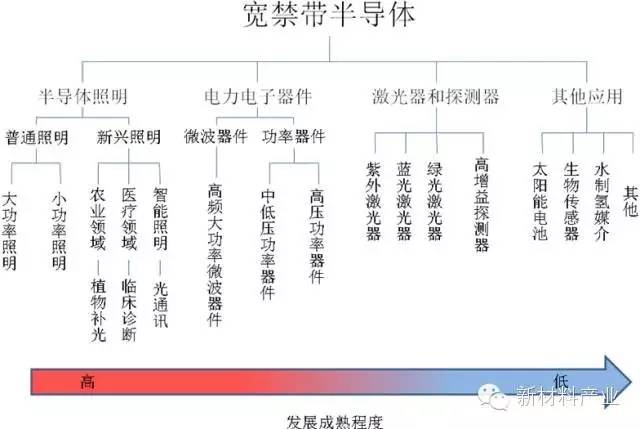
Figure 1. Schematic diagram of application areas for third-generation semiconductors
1. Semiconductor Lighting
Among the four application areas, the semiconductor lighting industry has developed most rapidly and has already grown into an industry worth tens of billions of dollars. The material systems used in semiconductor lighting are mainly divided into three types: sapphire-based GaN, SiC-based GaN, and Si-based GaN, with products from each material system corresponding to different applications. Among them, sapphire-based GaN is the most commonly used and most mature material system, and most LED lighting is manufactured using this material system. SiC-based GaN has higher manufacturing costs, but due to its better heat dissipation, it is very suitable for manufacturing low-energy-consumption, high-power lighting devices. Si-based GaN has the lowest manufacturing cost among the three material systems and is suitable for low-cost displays.
2. Power Electronic Devices
In the field of power electronics, the application of wide-bandgap semiconductors has just begun, with a market size of only a few hundred million dollars. Their applications are mainly concentrated in cutting-edge military equipment and are gradually expanding into civilian fields. In microwave devices, GaN high-frequency, high-power microwave devices have begun to be used in military radar, smart weapons, and communication systems. In the future, GaN microwave devices are expected to be used in civilian fields such as 4G–5G mobile communication base stations. In power devices, the application areas of GaN and SiC material systems differ. Si-based GaN devices are mainly used in low- and medium-voltage applications (200–1,200 V), such as switching power supplies for laptops, high-performance servers, and base stations; while SiC-based GaN is concentrated in high-voltage applications (>1,200 V), such as inverters for solar power generation, new energy vehicles, high-speed rail transportation, and smart grids.
3. Lasers and Detectors
In the application fields of lasers and detectors, GaN-based lasers can cover a very wide spectral range, enabling the fabrication of blue, green, and ultraviolet lasers and ultraviolet detectors. Violet lasers can be used to manufacture high-capacity optical discs, with data storage capacity 20 times that of Blu-ray discs. In addition, violet lasers can also be used in applications such as medical disinfection and fluorescence excitation light sources, with a total market capacity of 1.2 billion USD. Blue lasers can be combined with existing red lasers and frequency-doubled all-solid-state green lasers to achieve full true-color displays, enabling widespread application of laser televisions. Currently, the output value of blue lasers and green lasers is approximately 200 million USD; if technical bottlenecks are overcome, the potential output value will reach 50 billion USD. GaN-based ultraviolet detectors can be used in missile warning, satellite secure communications, various environmental monitoring, and chemical and biological detection, but industrialization has not yet been achieved.
4. Other Applications
In frontier research fields, wide-bandgap semiconductors can be used in solar cells, biosensors, water-to-hydrogen media, and other emerging applications. These hot areas are still in the laboratory R&D stage.
Among the above four application areas, semiconductor lighting and power electronic devices became the focus of attention in early 2014. The former is because the U.S. incandescent lamp ban took effect on January 1, 2014, stopping the sale of the best-selling 40 W and 60 W incandescent lamps, a move aimed at promoting compact fluorescent lamps, LED lamps, and other energy-efficient bulbs. As countries around the world successively introduce policies and regulations to fully phase out incandescent lamps, 2014 is expected to be the fastest-growing year for semiconductor lighting in the near term. The latter is influenced by the U.S. government's National Network for Manufacturing Innovation program. On January 15, 2014, President Obama announced the establishment of the Next Generation Power Electronics National Manufacturing Innovation Institute. Over the next five years, the institute will invest 70 million USD through the U.S. Department of Energy, leveraging more than 70 million USD in matching funds from enterprises and research institutions, to commit to the R&D and manufacturing of high-performance, cost-competitive semiconductor power electronic devices. The institute will be led by North Carolina State University, together with more than 25 companies, universities, and government agencies including ABB, Cree, Inc., RF Micro Devices, Inc., Delta Products Inc., Arkansas Power Electronics International, Inc., Toshiba International Corporation, and the U.S. Naval Research Laboratory. This move will greatly accelerate the application of wide-bandgap semiconductor power electronic devices in civilian fields and attract global attention. For these reasons, this article will focus on further introducing the recent developments in the above two areas.
II. Semiconductor Lighting
With the continuous advancement of lighting technology, semiconductor light-emitting diodes (LEDs), as solid-state lighting sources, are gradually replacing traditional incandescent lamps with advantages such as high luminous efficiency, long lifespan, energy conservation and environmental protection, and wide application, becoming another lighting revolution after incandescent and fluorescent lamps. LED lamps have about 80% higher luminous efficiency than traditional incandescent lamps, last twice as long, and contain no harmful substances such as mercury or lead. They can be safely touched and are a typical green lighting source. According to a U.S. Department of Energy research report, a 15 USD LED lamp will save more than 140 USD in electricity costs over its lifetime compared with an incandescent lamp.
In recent years, with the substantial improvement of LED luminous efficiency, the price per lumen has gradually decreased, various innovative products have continued to emerge, and lighting quality has continuously improved. Their applications have gradually expanded from the earliest indicator lights to indoor lighting, stage lighting, landscape lighting, and various other lighting fields. Currently, lighting accounts for about 20% of total electricity consumption, and reducing lighting electricity use has become an important way to save energy. To this end, developed countries have successively announced incandescent lamp phase-out plans and actively promoted LED lighting to address the increasing global greenhouse effect. The United States, the European Union, Japan, Canada, Australia, South Korea, and other countries have successively announced the cessation of incandescent lamp sales. China will also gradually phase out incandescent lamps from 2012 to 2016.
1. Overview of Foreign LED Industry Development
The United States is the leader in semiconductor lighting technology and has always maintained a leading position in technology and industry. To reduce energy consumption for lighting electricity and alleviate energy depletion, the U.S. Department of Energy began promoting solid-state lighting technology research in 2000, gradually realizing the replacement of traditional lighting with solid-state lighting. Subsequently, Obama's "New Energy Policy for America" made developing new and renewable energy, improving energy efficiency, and promoting energy structure adjustment the most important measures for promoting U.S. economic recovery and job creation. Semiconductor lighting technology is considered one of the important technological innovations in the energy application field and plays an important role in the transformation of the U.S. energy structure.
The U.S. Department of Energy's solid-state lighting strategic development plan received a total of 298 million USD in appropriations from the U.S. Congress and funded more than 200 research projects. This plan has achieved significant economic and social benefits. According to relevant research reports, in 2012 LED lamps saved the United States 71 trillion BTU (British thermal units), equivalent to saving 675 million USD in energy expenses. It is estimated that by 2030, the widespread adoption of LED lighting in the United States can save nearly half of energy consumption, and the cumulative electricity saved during 2010–2030 will reach 2,700 TWh, equivalent to saving 250 billion USD in expenses and equal to 1.8 billion t of CO2 emissions (see Figure 2).
In addition to the United States, other developed countries are also actively promoting the development of the LED industry. Japan launched the "21st Century Light Plan" as early as 1998, investing 6 billion yen to develop white LED lighting sources, with the goal of achieving 100% of lighting products as next-generation high-efficiency lighting by 2020. Europe launched the "Rainbow Plan" in 2000 to promote LED applications through EU subsidies. In the subsequently launched "Horizon 2020" plan, solid-state lighting and OLEDs were both included, with investment in the optoelectronics field reaching 700 million euros. South Korea proposed the "GaN Semiconductor Development Plan" in 2002, with the state investing 100 million USD to promote LED lighting development. In the subsequent "15/30 Plan," it invested another 5 billion won to formulate standards and specifications for LED lighting and planned to replace 30% of domestic lighting with LED lighting by 2015.
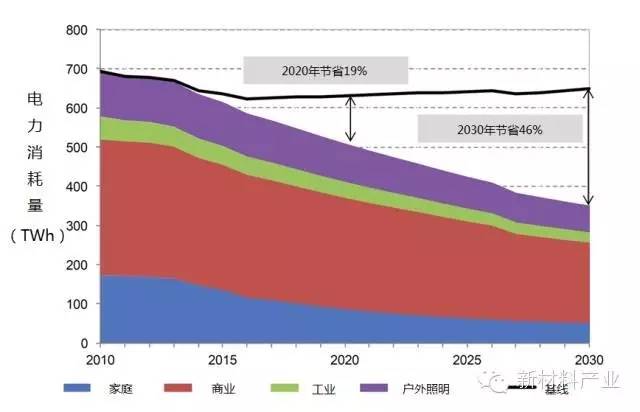
Figure 2. U.S. Department of Energy LED lighting forecast chart
2. Overview of China's LED Industry
China's LED industry started in the 1970s and has developed rapidly. With strong government support, after more than 30 years of development, a complete industrial chain covering epitaxial wafers, chips, packaging, and product applications has taken initial shape, making China one of the fastest-growing regions in the transformation and upgrading of the global lighting industry. Through the Ministry of Science and Technology's "Ten Cities, Ten Thousand Lamps" semiconductor lighting application demonstration project, by the end of 2011, more than 4.2 million LED luminaires had been demonstrated in applications, achieving annual electricity savings of 420 million kWh. According to the latest data from the China Solid State Lighting Alliance (CSA), in 2013, the industrialized luminous efficiency of power white LEDs in China reached 140 lm/W, the industrialized luminous efficiency of power silicon-based LED chips with independent intellectual property rights reached 130 lm/W, and the domestic production rate of chips reached 75%.
In 2013, the overall scale of China's semiconductor lighting industry reached 257.6 billion yuan, an increase of 34% over 192 billion yuan in 2012. Among them, the upstream epitaxial chip production output value reached 10.5 billion yuan, a growth rate of 31.5%; the midstream packaging industry scale reached 40.3 billion yuan, a growth rate of 26%; and the downstream application field overall scale reached 206.8 billion yuan, a growth rate of 36%. According to alliance forecasts, in 2014, the domestic semiconductor lighting industry will continue to maintain high-speed growth, with an expected growth rate of about 40%. The output value growth rate of epitaxial chips is expected to reach about 35%, the packaging industry is expected to grow at about 20%, and the output value growth rate of the application segment will exceed 50%.
3. Future Technology and Industry Development Directions
At the current stage, the overall luminous efficiency of LED lamps can reach 130–160 lm/W, already possessing the strength to replace the traditional lighting market. Luminous efficiency is expected to continue improving rapidly, reaching 160–190 lm/W in 2015 and about 235 lm/W by 2020 (see Table 2). At present, the key factor restricting large-scale LED application is still price. Although the selling prices of LED lighting products have dropped significantly over the past five years, they still do not have a price advantage compared with ordinary energy-saving lamps (see Figure 3). In recent years, with the impact of declining production costs and large capital inflows, this situation has begun to change, and the price gap between LED lighting and traditional lighting products is gradually narrowing. From late 2013 to early 2014, in many countries and regions, the lowest selling prices of LED lamps replacing either 40 W or 60 W lamps have fallen below 10 USD, and the global average prices of these two types of LED lamps have also dropped to low levels of 15 USD and 21 USD, respectively. Many people believe that the 10 USD price range will be a key turning point for large-scale household adoption of LED luminaires. Therefore, 2014 is very likely to become a year of rapid growth in LED lighting demand and a turning point year for LED lighting products. It is estimated that in 2014 the LED lighting penetration rate will also rise from 8%–10% to 32.7%, and the LED lighting market output value will reach 35.3 billion USD, growing 47.8% over 2013. By 2020, the global LED lighting market share is expected to grow to 84 billion USD.
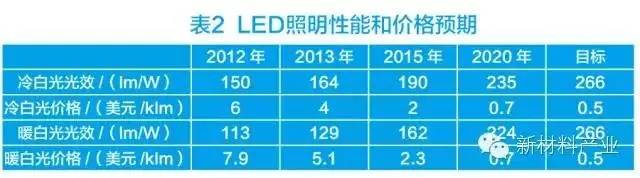
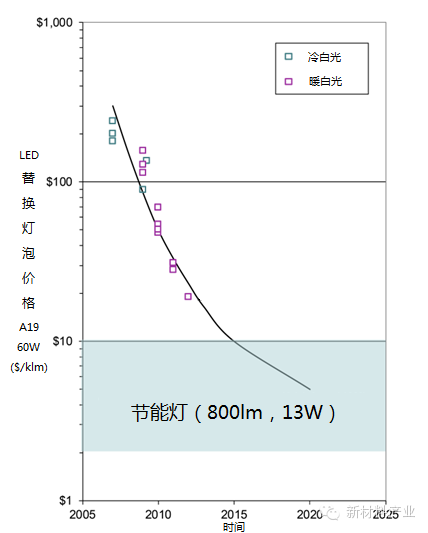
Figure 3. Expected price of LED bulbs replacing 60 W lamps
III. Power Electronic Devices
In the 20th century, silicon-based semiconductor power electronic devices were widely used in industries such as computers, communications, and energy, bringing people various powerful electronic devices and profoundly changing everyone's life, while driving scientific progress and development over the past decades. As silicon-based power electronic devices gradually approach their theoretical limits, power electronic devices manufactured using wide-bandgap semiconductor materials show superior characteristics to Si and GaAs, bringing new vitality to the development of the power electronics industry. Compared with Si materials, manufacturing a new generation of power electronic components using wide-bandgap semiconductor materials can make them smaller, faster, more reliable, and more efficient. This will reduce the mass, volume, and lifecycle cost of power electronic components, allow devices to operate at higher temperatures, voltages, and frequencies, and enable electronic devices to use less energy while achieving higher performance. Based on these advantages, wide-bandgap semiconductors have broad application prospects in systems such as home appliances, power electronic equipment, new energy vehicles, industrial production equipment, high-voltage direct current transmission equipment, and mobile phone base stations.
1. Military Applications
Initially, research and development on wide-band

