NF LI5660/LI5655/LI5650/LI5645 Loop Design Broadband Digital Phase-Locked Loop Amplifier
Model:LI5660/LI5655/LI5650/LI5645 Country of Origin:Japan
Category:Digital Phase-Locked Loop Amplifier
Overview:
A lock-in amplifier is a measuring instrument used to detect repetitive signals (AC) buried in noise. It can also be regarded as a highly sensitive AC voltmeter with noise immunity. During measurement, except in some special cases, a reference signal is required. In general, the signal source used for measurement is connected directly to the reference signal input terminal. It is widely used in physical and chemical research fields such as optical analysis.
Features
Specifications
Application Notes
Functions & Configuration
Digital Lock-in Amplifiers LI5660/LI5655/LI5650/LI5645
Lock-in amplifiers can detect very faint AC signals buried in noise, and are widely used in the most advanced research fields such as scanning probe microscopy, terahertz spectrometers, and spintronics. NF's latest lock-in amplifier LI5600 series are 2-phase, 2-frequency digital lock-in amplifiers, featuring excellent dynamic reserve of up to 100 dB, a maximum sampling rate of 1.5 M samples/s (LI5660/LI5655), high-speed and stable output response with 16-bit amplitude resolution, and various basic functions that improve the reliability of weak signal measurement. The LI5660 series is equipped with the latest functions, such as simultaneous 2-frequency measurement (not including LI5645) and fractional harmonic measurement, supporting high-level measurement requirements in various application fields.
Frequency range LI5660: 0.5 Hz to 11 MHz* *When used as high-frequency input LI5655: 0.5 Hz to 3 MHz LI5650/LI5645: 1 mHz to 250 kHz
Voltage measurement LI5660: 10 nV to 10 V*F.S. *When used as C input LI5655/LI5650/LI5645: 10 nV to 1 V F.S.
Current measurement 10 fA to 1 μA F.S. (not including LI5645)
Minimum time constant LI5660/LI5655: 1 μs LI5650//LI5645: 5 μs
Dynamic reserve 100 dB or more
Analog output refresh rate LI5660/LI5655: up to approx. 1.5 M samples/s LI 5650/LI5645: up to approx. 750 k samples/s
Dual-frequency simultaneous measurement (LI5660/LI5655/LI5650) Equipped with 2 sets of 2-phase detectors, simultaneously measuring 2 frequency components.
Fractional harmonic measurement Measurement at frequencies that are fractional multiples of the fundamental (1 to 63) / (1 to 63)
External 10 MHz sync input Using an external reference frequency, it can stay synchronized with the frequency standards of other devices.
Measurement parameters: X, Y, R, θ, DC, Noise
Interfaces: USB, GPIB, LAN
Slim 2U size (88 mm)
Model
LI5660
LI5655
LI5650
LI5645
LI5640
Frequency range
0.5 Hz to 11 MHz
0.5 Hz 至 3 MHz
1 mHz 至 250 kHz
1 mHz 至 250 kHz
1 mHz 至 100 kHz
Signal input
Voltage
(A, A-B)
✓
✓
✓
✓
✓
10 Vrms Input (C)
✓
HF Input (HF)
✓
Current (I)
✓
✓
✓
✓
Sensitivity
Input voltage
A, A-B: 10 nV 至 1 V F.S. (0.5 Hz 至 3 MHz) C: 1 mV 至 10 V F.S. (0.5 Hz 至 3 MHz) HF: 2 mV 至 1 V F.S.. (10 kHz 至 11 MHz)
10 nV 至 1 V F.S.
10 nV 至 1 V F.S.
10 nV 至 1 V F.S.
2 nV 至 1 V F.S.
Input current
10 fA 至 1 μA F.S.
10 fA 至 1 μA F.S.
10 fA 至 1 μA F.S.
5 fA 至 1 μA F.S.
Input reference noise voltage
4.5 nV/√Hz (Supplementary value)
4.5 nV/√Hz (Supplementary value)
4.5 nV/√Hz (Supplementary value)
4.5 nV/√Hz (Supplementary value)
4.5 nV/√Hz (typ.)
PSD
2Phase, 2PSDs
2Phase, 2 PSDs
2Phase, 2 PSDs
2Phase, 1 PSD
2Phase, 1 PSD
Dynamic reserve
100 dB
100 dB
100 dB
100 dB
100 dB
Time constant
1 μs 至 50 ks
1 μs 至 50 ks
5 μs 至 50 ks
5 μs 至 50 ks
10 μs 至 30 ks
Analog output maximum update rate
Approx. 1.5 M samples/s
Approx. 1.5 M samples/s
Approx. 780 k samples/s
Approx. 780 k samples/s
256 k samples/s
Sub-harmonic measurement
✓
✓
✓
✓
Dual-frequency simultaneous measurement
✓
✓
✓
External10 MHzSync input
✓
✓
✓
✓
Measurement parameters
X, Y, R, θ, DC, NOISE
X, Y, R, θ, DC, NOISE
X, Y, R, θ, DC, NOISE
X, Y, R, θ, DC, NOISE
X, Y, R, θ, DC, NOISE
Remote control interface
USB, GPIB, RS-232, LAN
USB, GPIB, RS-232, LAN
USB, GPIB, RS-232, LAN
USB, GPIB, RS-232, LAN
GPIB, RS-232
High-speed response and high stability
Time constant
Time constant
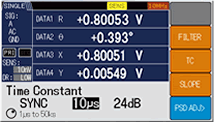
The minimum time constant is 1 μs for the LI5660/LI5655 (5 μs for the LI5650/LI5645). Our latest lock-in amplifiers achieve high-speed response and high stability.
Synchronous filter
This is an integer-period moving average filter. Ripple caused by detection is greatly reduced, and the output is almost at the averaging interval (integer periods), so the time constant can be reduced (to obtain a faster response)
High-speed lock even at low frequencies
Even at low frequencies, it takes only about two periods to lock onto the reference signal. In addition, a moving average filter synchronized with the signal period achieves high-speed response with small ripple.
Excellent dynamic reserve
Phase detection and subsequent digital processing. At high gain, output zero drift is less than in analog systems, and dynamic reserve of up to 100 dB can be obtained (testing can be performed with noise 100000 times the sensitivity, i.e., a full-scale signal).
Up to 11 MHz wideband, high-frequency input terminal (LI5660)
Voltage measurement can be performed with single-ended (A) or differential (A-B) input, and the LI5660 terminal has both a 10 Vrms input (C) and a high-frequency (HF) input. The HF input can be used for measurements up to 11 MHz.
Sub-harmonic measurement
Measurement can be performed at frequency factors (1 to 63)/(1 to 63) of the fundamental waveform factor. Measurement at integer multiples of the fundamental waveform order is provided. In the dual-frequency measurement mode of the LI5660/LI5655/LI5645, the individual frequencies of the first PSD and the second PSD can be set. For example, the first PSD can be set to N/M of the reference signal frequency, and the second PSD can be set to a frequency similar to N times the reference signal or to a frequency different from the main frequency.
Sub-harmonic
Harmonic measurement is performed at an integer multiple between two measurement frequencies (f2 = (f1 x n)). In this case, the signal at f1 results in an integral multi-frequency (harmonic) distortion that cannot be distinguished from the f2 signal. In the case of fractional harmonic testing, the test can be performed with the relationship f2 = f1 x n/m, which means that even if distorted harmonics are generated from f1, the frequency can be set so as not to affect f2. High-sensitivity harmonic measurement of f2 is feasible and is not affected by the harmonics of f1.
Dual-frequency simultaneous measurement of 2 phases (Rcosθ, Rsinθ), 2 PSDs (main PSD, sub PSD)
The LI5660/LI5655/LI5650 is equipped with 2 phase-sensitive detectors (PSDs), allowing simultaneous measurement of two frequency components contained in a single input signal. Whereas two lock-in amplifiers were previously required, the dual-beam method requires only one lock-in amplifier. A ratio operation of the measured value to the reference value can be obtained, and the main detector can be cascaded with the sub detector, so that after the main detector detects the signal, the sub detector can then perform detection.
Detection mode (Dual 1)
Detection mode Main PSD Sub PSD Function SINGLE* Fundamental / Sub-harmonic None 1 frequency 2-phase detection. DUAL1 Fundamental / Sub-harmonic Fundamental / Harmonic Simultaneously measure the fundamental and its harmonic components contained in one input signal DUAL2 Main frequency Sub frequency Simultaneously measure two independent frequency components contained in one input signal CASCADE Main frequency Sub frequency Cascade the main PSD and sub PSD.
* The detection mode of the LI5645 is only "Single" mode.
External 10 MHz synchronization
Allows the LI5600 series to operate synchronously with a common 10 MHz frequency source such as a signal generator or other equipment (configurable) without using an external reference signal (REF IN).
External 10 MHz reference signal input setting
Slim and compact, packing multiple functions
LI5660
Signal processing for SPM (scanning probe microscopy)
Scanning probe microscopes such as STM (scanning tunneling microscopy) and AFM (atomic force microscopy) scan a sample surface with a nanoscale probe and detect the signal between the probe and the sample, observing the electronic state, structure, and physical and chemical properties of the sample surface. Lock-in amplifiers are used to control the distance between the sample and the probe, etc. With the LI5600 series, not only are high harmonic frequencies in the MHz range supported, but high-speed scanning is also achieved by reducing the time constant (from 1 μs), enabling images to be formed in a short time. In addition, the synchronization filter greatly reduces fluctuations in the phase detection output, which not only improves speed but also helps achieve high image quality. In addition to STM and ATM, lock-in amplifiers are also used for signal processing such as demodulation of modulation signals in KFM (surface potential microscopy).
Measurement of transmitted light intensity (elimination of light source fluctuations)
If the dual-frequency simultaneous measurement and fractional harmonic measurement functions are used together, a single LI5660/LI5655/LI5650 can perform fluctuation correction of light sources, etc. in the dual-beam method (ratio measurement). By applying negative feedback through the signal of the reference unit, stabilization of light source intensity can also be achieved. Integer multiples (n x), integer fractions (1/m x), and fractional ratios (n/m x) of the reference signal can be set, allowing flexible response to optical modulation frequency ratios. In addition, in the case of integer ratios, harmonic components caused by signal distortion cannot be distinguished, but with fractional ratios there is no influence from harmonics. In addition, by using the 10 MHz synchronization function to stay synchronized with an external signal generator, detection using any 2 frequencies is also possible.
Hall coefficient measurement (beat-frequency measurement)
The Hall voltage is proportional to the product of two signals (current and magnetic field), and its frequency is the difference (or sum) frequency of the two signals. By synchronizing the LI5600 series external signal sources that generate the current and magnetic field at an external 10 MHz, difference-frequency signal measurement is possible for any two different frequencies even without an external reference signal (difference frequency) (e.g., using a signal generator with dual-channel output and frequency reference output).
If the original frequency is an integer ratio, the fractional harmonic measurement function can also be used to measure the difference-frequency signal. In addition, crosstalk caused by external reference signals can be avoided in all cases.
Other applications
Spectroscopy (Auger electron spectroscopy, photoacoustic spectroscopy, Raman spectroscopy, etc. used in materials science) Measurement of optical properties (intensity, absorption, scattering, transmission, etc.) Optical applications (optical gyroscopes, distance detection, speed, vibration, etc.) Magnetic measurement (evaluation of magnetic materials, vibrating magnetometers, magnetic detection using SQUID) Evaluation of various sensors (optical, magnetic, and piezoelectric elements for measured physical quantities, chemical changes, etc.) Zero-point detection of impedance bridges Impedance measurement (minute impedance, minute capacitance, chemical impedance) Measurement of thermal diffusivity of thin-film materials.
Looking for more sales, technical and solutions information?
 Technical Support
 Feedback